Posts

Working From Europe? Questions Surrounding NFF's agenda for Nigeria

Reading recently that Nigeria's new national team coach, Sunday Oliseh, will be primarily based in Europe came as a shock to me for several reasons. Conventionally, the primary residence of Nigeria's national team coach has always  been controversial, particularly when the appointee is someone without Nigerian citizenship. In fact, there has always been an insistence that the coach maintain primary residence in Nigeria and often a long-term accommodation for the coach becomes part of the contract. Often, a Nigerian-born appointee (such as Oliseh) is expected to reside in Nigeria and thus the issue is mute. Thus, it was a surprise to read that Oliseh will be resident in Europe. Of course, one could argue that most of Nigeria's internationals reside in Europe and, thus, it makes little sense for the national team coach to be based in Nigeria. That, of course, is a perfectly reasonable argument but only sustainable if Oliseh's charge was merely to coach the Nigerian nati...
Interpreting the Move to Hire Oliseh and the issue of a Foreign Coach. . . .

The story below is directly from Nigerian Football Federation's (NFF) website and, thus, must be considered accurate. You can find the story by clicking on NFF . Reading the story leads me to the following interpretations: 1.      Sunday Oliseh’s job is far more reaching than had been the case with previous national team coaches. He will not only coach the A squad but will oversee Nigeria’s football by beginning the process of codifying it and outlining its culture. Essentially, he takes over a task that was supposedly Shuaibu Amodu’s. 2.      Pinnick did get his wish for a foreign technical imprint on Nigeria’s football.   In fact, not only did Pinnick get what many thought he was focused on but he got more! The designated Foreign Assistant is only such by name. In essence, that Assistant will have (by all intents and purposes) far reaching influence. He will oversee the entire youth development. My sense is that because those youth...

Vicissitudes of Explaining Soccer Results by focusing on Coaching....

Image
In spite of widespread knowledge of human behavior and an understanding of general systems, there remains a willingness to explain football results solely by the simplistic ideas that: "all results derive from coaching." This is misleading and retrogressive. It reeks of, perhaps, lazy analysis or simply an inability to deal with complexities and, thus, a willingness to chase the "simple route." In this brief piece, I do not focus on providing statistics to expose the fallacy of "all results derive from coaching." Instead, I assume that what we all understand in the statement "football is not mathematics" should open the window to the universal truth that football results expectedly feature "up and downs" and unpredictabilities, which are the crux of game's excitement. No coach has been able to buck that trend nor will there be a coach to do so. At best, a 'good' coach will provide a certain probability o...

Data: Super Eagles and set-pieces.....

Image
In this piece I take a look at data on set-peice goals scored by Nigeria in two competitions -- the Cup of African Nations (CAN) and the World Cup. We use the complete World Cup statistics for Nigeria and in the CAN we select the last five tournaments that Nigeria was a participant. The data show remarkable difference between the two competitions. Nigeria has done much better in the percentage of goals scored via set-piece and the percentage conceded via set-piece in the CAN compared to the World Cup. An obvious argument here is that Nigeria faces much better competition in the World Cup and this is demonstrated in the records of games played in the two competitions. The World Cup Nigeria's record of set-piece goals is poor. Nigeria has scored just 20% of its World Cup goals from a set-piece compared to conceding more than half of goals scored by opponents from set-piece. In essence, Nigeria has only conceded 12 goals from open play in the World Cup. This means less than a goa...

Global Perspective: Exploring Youth Development Outcomes in Competitions

Image
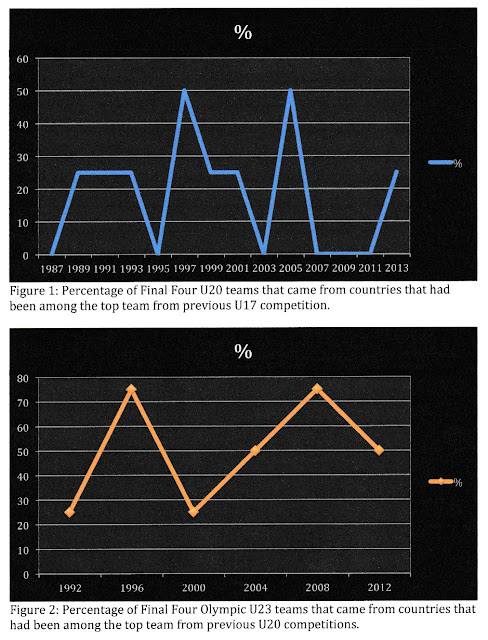
One of the goals of the Federation of International Football Associations (FIFA) is to develop youth football and improve the game at the senior national team level. Of course, many could argue that this has been achieved already with faster and better tactical and technical play at the most senior level. However, one of the questions is whether there is a correlation between success at the lower youth level and success at the older levels. In essence, if a country performs well at a youth level, does that performance predict success at the higher level in a few years? In this piece, we explore that question. The result here is exploratory and must be interpreted with extreme caution as it does not meet with strict requirements of scientific study. For instance, we have not looked at team rosters in order to answer the question nor have we controlled for effects of extraneous variables. Instead, we simply compared data on teams that reached the semi-final stages (Top Four) of U17,...

Bracing for the 2017 Cup of African Nations Qualifiers....

Image
Usually, Nigeria's qualification for the finals of the Cup of African Nations (CAN) is taken for granted. This has been the case since the mid 1970s after Nigeria became a footballing power in the continent. However, Nigeria has only made it to the finals of the tournament once in the last three editions! That is a shocking record considering the country's footballing pedigree. But to reach the 2017 finals may well be more difficult than any qualifiers that Nigeria has been involved in for a long time, at least on paper. The major obstacle is Egypt, a country that has won the CAN more times than any other country. Yet only one of Nigeria or Egypt can be sure to make it. The chances of a second place team making it from the group is a crap shoot. Egypt will be just as desperate as Nigeria to be at the finals of the 2017. Egypt has missed the last three finals! Thus, the only guarantee is a battle to finish between the two. One must acknowledge that even though Egypt is co...

Youth Football: Flying Eagles to Super Eagles. . . .

Image
A few days ago, we provided data showing number of players who progress from Nigeria's U17 to the full national team -- Super Eagles. In this piece, we use similar methods to show the progression from U20 Flying Eagles to the Super Eagles. As should be expected, the results are better from the U20 level to the full national team. Key to Understanding the Method and Results Note that only U20 squads that participated at the FIFA World Youth Cup (WYC) have been used for this analysis. In essence, this covers 10 squads from 1983 until 2013. With the 2013 squad, we do not conduct all analyses because this squad is recent and more of its players are expected to do more at the Super Eagles level in a few years to come. New data provided in this piece compares the U17 and U20 squads in terms of average number of players from each squad that progress to the Super Eagles. This is provided in Figure 1. While just about four (4) players from a U17 squad are likely to play a game  at the ...